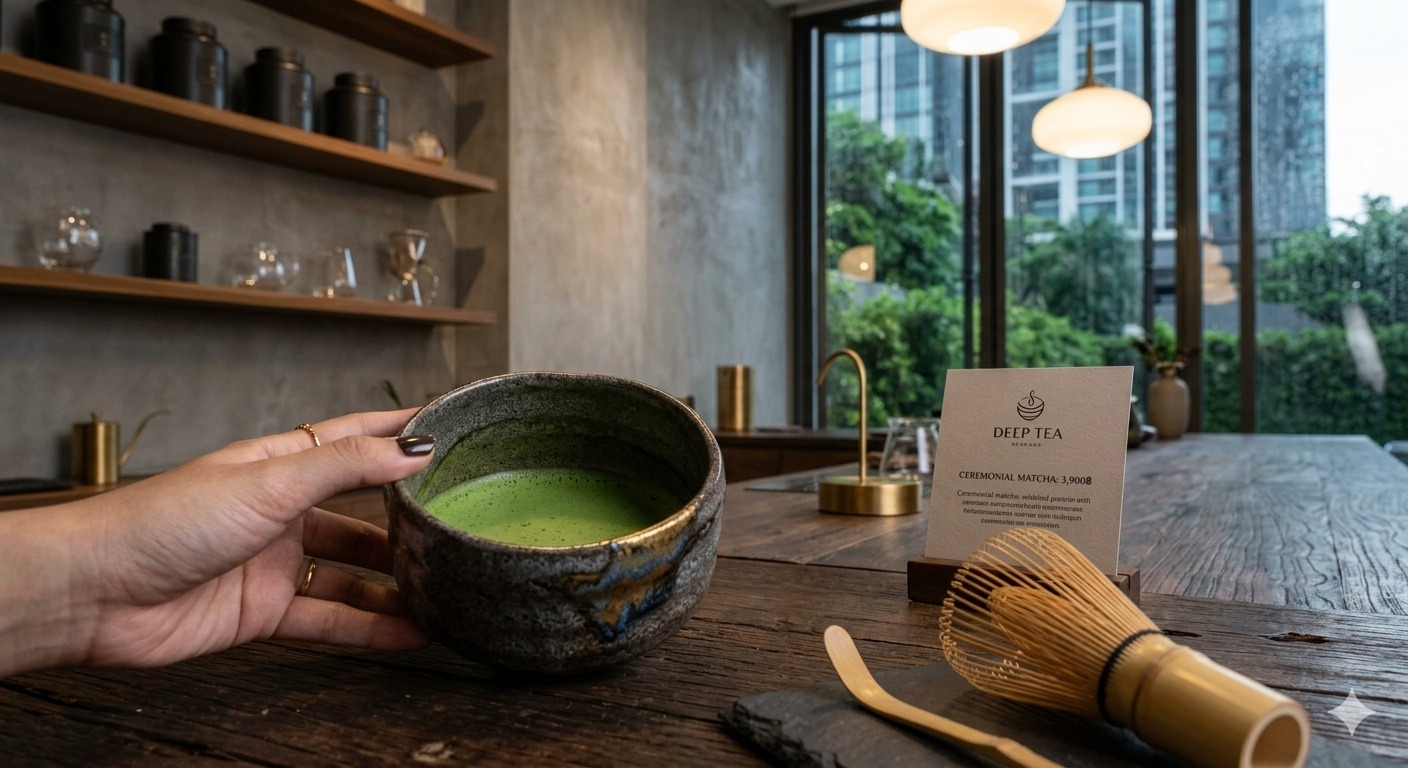
In a city like Bangkok where a refreshing glass of Thai iced tea can be found on nearly every street corner for 50 baht, a new trend is brewing that pushes the boundaries of luxury.
At Deep Tea in Ladprao, a single cup of ceremonial matcha is currently retailing for a staggering 3,900 baht (approximately $107 USD).
While the price tag might seem like a typo, the venue is far from empty.
This phenomenon offers a fascinating look at the evolving landscape of Thailand’s “lifestyle economy” and how a simple green powder has become the city’s ultimate status symbol.
Beyond the Plastic Cup
For the price of a high-end dinner for two, customers receive roughly 200 milliliters of whisked tea. So, what exactly are they paying for?
According to connoisseurs, it is a masterclass in provenance and precision:
-
The Origin: The tea is a specific grade of stone-ground matcha sourced from Uji, Kyoto—the “holy grail” region for Japanese green tea.
-
The Ritual: Each cup is prepared using traditional tools, including a bamboo whisk (chasen) and hand-crafted ceramic bowls (chawan).
-
The Grade: This is “ceremonial grade” in its purest form, far removed from the “culinary grade” powders used in mass-market lattes and croissants.
Matcha as a Performance of Discernment
Bangkok’s obsession with matcha has followed a classic luxury trajectory. It began as an aesthetic trend on social media, favored for its vibrant green hue and association with Japanese minimalism.
Now, it has transitioned into a “performance of discernment.”
Paying 3,900 baht for a cup of tea is as much about the taste as it is about the statement.
It signals that the consumer knows the difference between “first flush” and “second flush” leaves, or “stone-ground” versus “blade-ground” processing.
In a city that absorbs global prestige markers with unique flair, the high-end matcha bowl has become the new vintage wine or rare coffee bean.
The “Trickle-Down” Effect
Interestingly, the rise of the ultra-premium tier hasn’t hurt the mass market; it has fueled it.
As “tea influencers” showcase these luxury rituals on TikTok and Instagram, curiosity trickles down to the general public.
This heightened awareness has actually boosted sales for mid-range cafés, as people seek out the best version of matcha within their own budgets.
Whether the 3,900-baht price tag is a justified expense or a pinnacle of “aesthetic inflation” depends entirely on the person holding the bowl.
However, one thing is clear: in Bangkok’s competitive food scene, tea is no longer just a beverage, it’s an experience, a ritual, and for some, a very expensive work of art.
Follow Thailand Secret on X, Facebook, Instagram, Youtube, TikTok, WhatsApp, Telegram, Rumble
Have any thoughts?
Share your reaction or leave a quick response — we’d love to hear what you think!
-
 1
-
 0
-
 0
-
 0
-
 0
-
 0