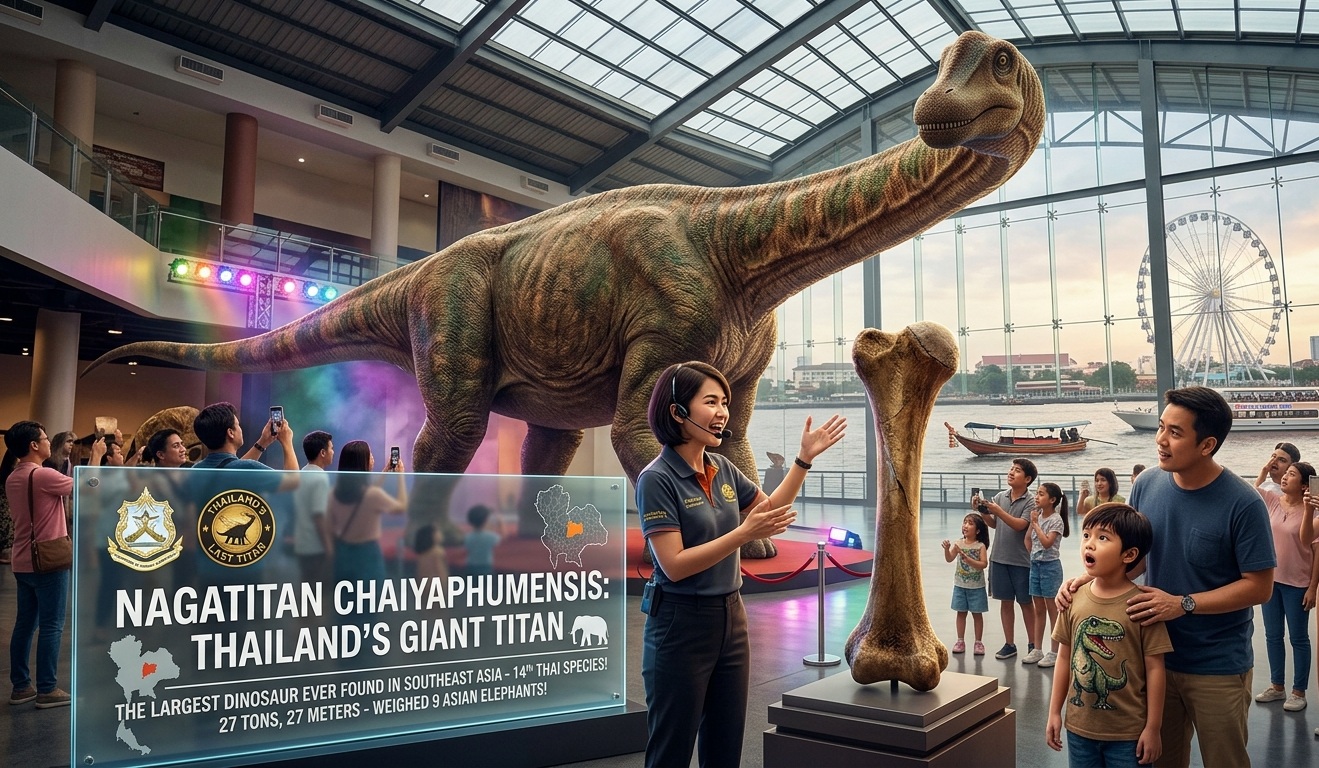
CHAIYAPHUM — Move over, T-Rex. Thailand has officially introduced the world to its newest, and by far largest, prehistoric resident.
In a joint study published in the journal Scientific Reports, paleontologists from Thailand and the UK revealed the discovery of a Nagatitan chaiyaphumensis.
The name combines “naga”, the mythological serpent of Southeast Asian folklore, “titan” in reference to its size, and “chaiyaphumensis” meaning “from Chaiyaphum”, the province where the fossils were found.
Roaming the earth between 100 and 120 million years ago during the Early Cretaceous period, this massive, long-necked herbivore holds the crown as the largest dinosaur species ever identified in Thailand and the broader Southeast Asian region.
A 27-Ton Prehistoric Behemoth
To wrap your head around its scale, researchers estimate that Nagatitan (Nakha Titan) stretched an incredible 27 meters (89 feet) in length and weighed roughly 27 tonnes.
-
Weight Check: That is equivalent to the heft of nine adult Asian elephants.
-
The “Human-Sized” Leg: Just one of its front leg bones (the humerus) measured 1.78 meters long—roughly the height of an average human.
-
Size Comparison: Lead author Thitiwoot “Perth” Sethapanichsakul, a Thai doctoral student at University College London (UCL), noted that Nagatitan likely weighed at least 10 tonnes more than the famous Dippy the Diplodocus.
What’s in a Name?
The name Nagatitan chaiyaphumensis weaves together local folklore and global science:
-
“Naga” refers to the mythical, serpent-like aquatic deities deeply revered in Thai and Southeast Asian culture.
-
“Titan” nods to the massive giants of Greek mythology.
-
“Chaiyaphumensis” honors Chaiyaphum, the northeastern Thai province where a local villager first spotted the fossil remains poking out near the edge of a pond a decade ago.
Thailand’s “Last Titan”
Researchers have affectionately dubbed the new species Thailand’s “last titan”.
This is because the fossils were excavated from the youngest known dinosaur-bearing rock formations in the country. Shortly after Nagatitan’s era, rising global temperatures and sea levels transformed prehistoric Thailand into a shallow sea, meaning this is likely the last giant sauropod we will ever find in the region.
During its lifetime, northeastern Thailand was an arid-to-semi-arid plateau featuring a meandering river system.
Nagatitan shared this environment with prehistoric crocodiles, freshwater sharks, flying pterosaurs, and fearsome, 8-meter-long apex predators from the carcharodontosaurian family, though at full size, Nagatitan was so massive it had very little to fear from predators.
Want to See It in Person?
Nagatitan marks the 14th unique dinosaur species to be formally named and registered in Thailand, cementing the country’s reputation as one of Asia’s richest hotspots for paleontological diversity.
If you want to come face-to-face with this giant, you don’t have to trek out into the jungles of Isaan. A life-size reconstruction of Nagatitan chaiyaphumensis is currently on public display at the Thainosaur Museum at Asiatique right in Bangkok.
For more information regarding the scale of the discovery and interviews with the paleontologists involved, check out this News report on Southeast Asia’s largest dinosaur.
This video on France24 provides direct footage of the scale of the bones and details regarding its placement in Thailand’s prehistoric timeline.
Support our work: Click Here
Best Travel Insurance: click here
Best VPN for Travel: click here
Have any thoughts?
Share your reaction or leave a quick response — we’d love to hear what you think!
-
 2
-
 0
-
 0
-
 0
-
 0
-
 0