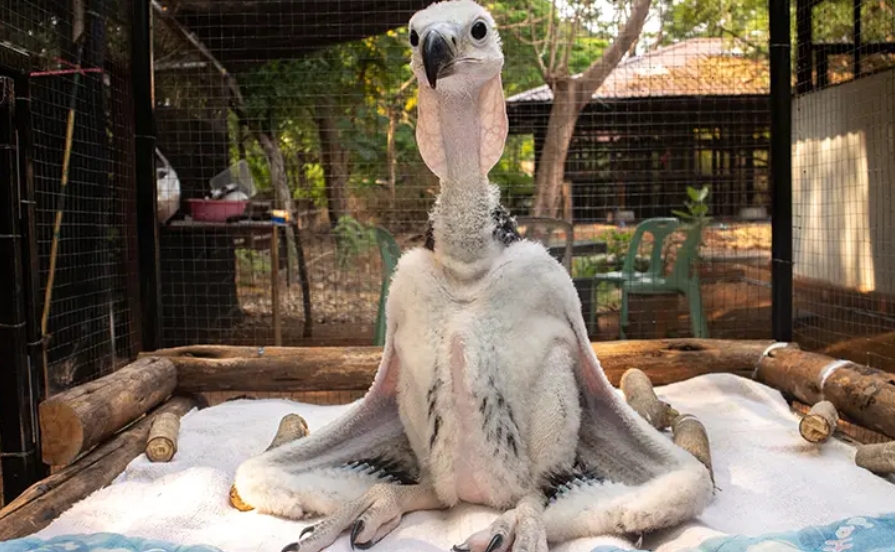
Four times a day, Watchiradol Phangpanya suits up in a long-sleeved black shirt, red gloves, and a red hood. His goal is to look as much like a red-headed vulture (also known as the Asian king vulture) as possible while feeding a newborn of this critically endangered species.
The pink-skinned, white-downed chick is a massive milestone: it is the first red-headed vulture to be bred in captivity in Asia, and only the second in the entire world.
The Thai conservationist and his colleagues at the Nakhon Ratchasima Zoo, located in Nakhon Ratchasima province (also known as Korat) in northeastern Thailand, are taking extreme precautions.
They want to ensure that any captive-born chicks do not imprint on humans, safeguarding their future chances of being successfully released into the wild.
“It is necessary […] to disguise ourselves as the bird so that it sees an appearance closest to what its parents would look like,” explains Phangpanya, adding that this is the best way to develop the bird’s natural instincts.
Diet and Ecosystem Impact
Phangpanya feeds the chick a varied diet of rabbit, deer, chicken, and rat meat to mimic what it would consume in the wild. After eating, the chick basks in the sun to absorb the Vitamin D crucial for its physical and behavioral development.
“Is there enough nutrients in its food? Or is there too much? The anxiety is there at every single moment,” Phangpanya admits.
As scavengers, red-headed vultures play a vital role in the ecosystem by consuming animal carcasses and preventing the spread of diseases. However, hunting and habitat loss have driven the species to extinction in the wild in Thailand, with its global population suffering a severe decline.
Looking Toward the Skies
After nearly two decades of trying to revive the red-headed vulture population, the northeastern Thai zoo is finally seeing its efforts pay off.
Another egg is currently being incubated by its parents in captivity, and the team hopes to establish a large enough population for a future rewilding program.
“The most crucial aspect of our success would be to improve the ecosystem of the Huai Kha Khaeng Wildlife Sanctuary, a UNESCO World Heritage site,” says Zoo Director Thanachon Kensingh. He notes that the sanctuary was once home to Asia’s largest community of red-headed vultures.
“We would love to see the red-headed vulture fly through the skies of Thailand once again,” Kensingh says.
Support our work: Click Here
Best Travel Insurance: click here
Best VPN for Travel: click here
Have any thoughts?
Share your reaction or leave a quick response — we’d love to hear what you think!
-
 0
-
 0
-
 0
-
 0
-
 0
-
 0