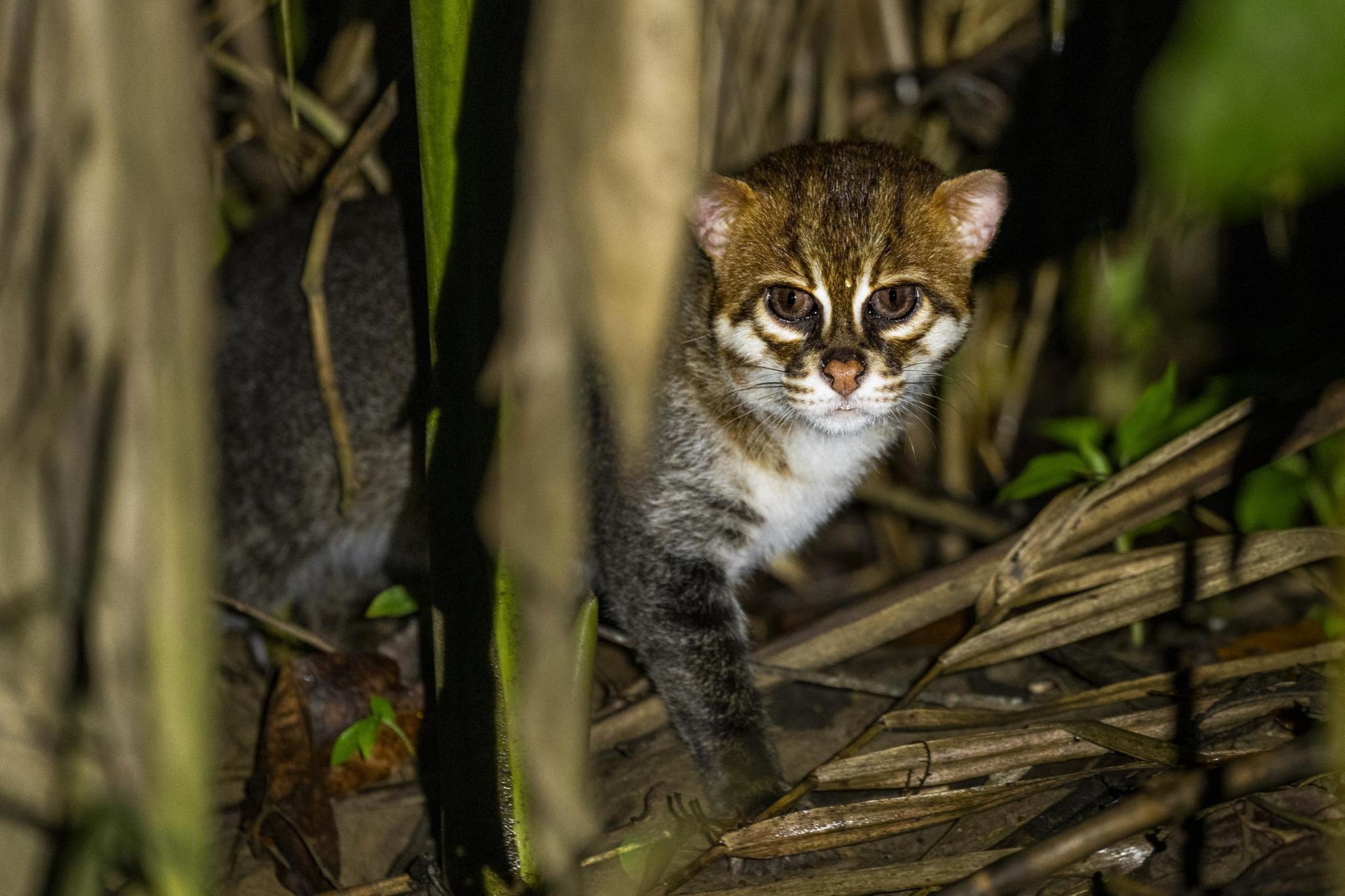
Ghosts in the Swamp: The Return of Thailand’s Rarest Shadow
While most people are busy chasing tigers or spotting elephants in Khao Yai, something far more mysterious has just emerged from the dark.
For 29 years, the Flat-headed cat was a ghost. In the scientific world, it was “possibly extinct” in Thailand. But the jungle has a way of keeping secrets until it’s ready to reveal them. Deep in the peat swamps of the Deep South, the shadow has returned.
The 29-Year Silence
Since 1995, there hadn’t been a single confirmed sighting of Prionailurus planiceps in the Kingdom. Imagine three decades of silence. Conservationists searched, cameras waited, and the world assumed the worst.
Then, in the Princess Sirindhorn Wildlife Sanctuary in Narathiwat, the cameras blinked. Not once, but 29 times over the last two years.
The most incredible part? They caught a mother with her cub. This isn’t just a stray traveler passing through; it’s a family. The lineage survived.
A Cat That Thinks It’s an Otter
If you saw one, you might not even think it’s a cat. These creatures are the “glitch in the matrix” of the feline world:
-
The Look: They have long, narrow skulls and flattened foreheads (hence the name).
-
The Lifestyle: While most cats hate water, these guys live for it. They have webbed feet and a tubular body designed for swimming. They don’t hunt mice in the attic; they hunt fish in the swamp.
-
The Size: They are tiny—less than half the size of your average house cat—but they are the apex predators of their muddy, watery domain.
Why They Disappeared (And Why They’re Back)
The flat-headed cat is the ultimate specialist. They don’t just need “the jungle”—they need the swampy, messy, peat-filled wetlands of the South. As land was converted for palm oil and agriculture, their world shrank until it vanished.
The Secret to their Survival? The remote nature of Narathiwat.
In a region that sees fewer tourists and less “development” than the rest of the country, nature was able to tuck itself away.
The local Muslim communities in the area also play an accidental role in their protection; they don’t hunt these animals for food or trade, allowing the cats to move through the shadows undisturbed.
The Reality Check
Don’t book a ticket to Narathiwat expecting to see one. These are nocturnal, elusive, and move through terrain that would swallow a human whole. They are masters of the “unseen.”
But that’s the beauty of Thailand’s wild heart. Just when we think we’ve mapped every inch, counted every species, and ruined every habitat, the jungle proves us wrong.
The return of the Flat-headed cat is a reminder that if we leave enough space for the wild, the wild will find a way to stay.
Follow Thailand Secret on X, Facebook, Instagram, Youtube, WhatsApp, TikTok, Telegram, Rumble.
Have any thoughts?
Share your reaction or leave a quick response — we’d love to hear what you think!
-
 0
-
 0
-
 0
-
 0
-
 0
-
 0