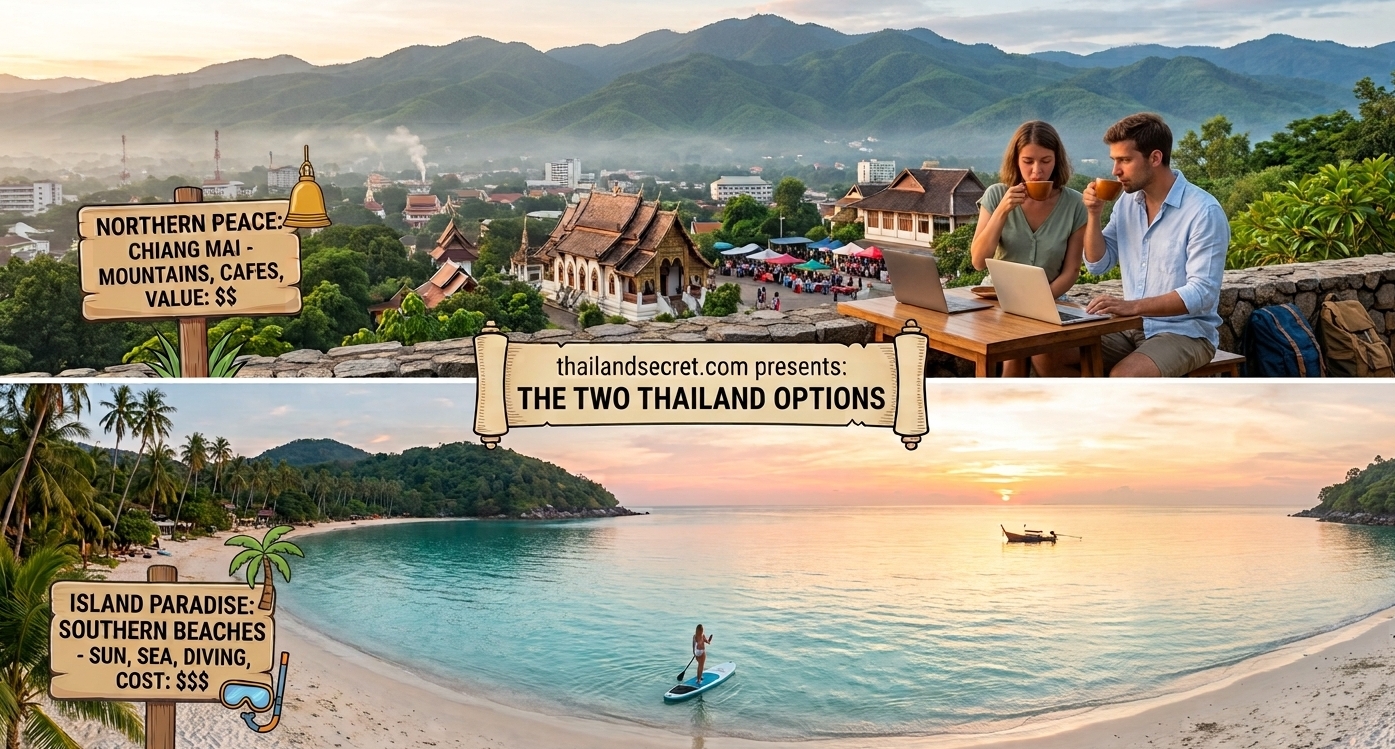
For expats, digital nomads, and long-term travelers, Thailand offers two distinctly different paths to paradise: the cool, mist-shrouded peaks of northern Thailand or the turquoise waters and white sand beaches of the south.
While both promise an enviable quality of life, living in Chiang Mai versus a coastal beach town (such as Phuket, Koh Samui, or Krabi) involves fundamentally different daily realities, budgets, and lifestyles.
Here is a breakdown to help you determine where to drop anchor in the Land of Smiles.
1. Cost of Living: Budget-Friendly North vs. Island Premium
One of the sharpest contrasts between northern Thailand and the southern coastline is price.
Chiang Mai consistently ranks as one of the most affordable digital nomad and expat hubs in Southeast Asia, whereas southern beach destinations carry a noticeable “island premium.”
-
Housing: A modern, fully furnished condo in Chiang Mai’s trendy Nimmanhaemin or Santitham districts typically ranges from 8,000 to 15,000 THB ($220–$420 USD) per month.
In contrast, a similar studio or one-bedroom near the beach in Phuket or Koh Samui often starts at 18,000 to 35,000+ THB ($500–$980+ USD). -
Dining & Street Food: Northern markets offer world-class meals, like a steaming bowl of Khao Soi—for 40 to 60 THB ($1.15–$1.70 USD). Seafood and Western dining in coastal towns cater heavily to short-term tourists, driving average meal prices up by 30% to 100%.
-
Daily Expenses: Transportation, gym memberships, and basic services are noticeably cheaper across Chiang Mai than in southern resort towns where transport monopolies (like island taxi rates) can quickly eat into your monthly budget.
2. Atmosphere & Lifestyle: Mountain Cafe Culture vs. Island Rhythm
Chiang Mai: The Creative & Active Expat Hub
Chiang Mai feels less like a fast-paced metropolis and more like a collection of interconnected villages tucked into the mountains.
-
World-Class Coffee Culture: Chiang Mai sits right next to Thailand’s primary coffee-growing regions in Chiang Rai and Fang. The city is packed with artisanal roasters, cozy cafes, and work-friendly spaces equipped with high-speed Wi-Fi.
-
Community & Networking: Because of its lower entry costs and established infrastructure, Chiang Mai hosts an incredibly active expat community. From co-working space meetups and language exchanges to weekly trail-running groups and artisan workshops, making connections here is seamless.
-
Outdoor Exploration: Instead of water sports, days off in the north involve mountain biking in Doi Suthep-Pui National Park, visiting hidden waterfall cafes, or taking weekend road trips through the winding turns of Mae Hong Son and Pai.
Coastal Towns: The Tropical Beach Reality
Living by the ocean delivers an iconic tropical lifestyle, but it comes with a different pace and social atmosphere.
-
Sun, Surf, and Sea: If your ideal morning involves paddleboarding, sunset swims, or weekend island-hopping, the south is unbeatable. Marine life, diving opportunities, and pristine coastline are right at your doorstep.
-
Transient vs. Settled Communities: Beach destinations tend to attract a higher percentage of short-term vacationers. While there are strong expat pockets in areas like Rawai (Phuket) or Srithanu (Koh Phangan), the social scene can feel more transient compared to Chiang Mai’s long-stay community.
-
Slower, Resort Pace: Coastal life revolves around the elements. Life moves at a laid-back, resort-style rhythm where days are structured around the tides, weather, and sea breeze.
3. Climate & Environment: Mountain Seasons vs. Tropical Ocean
| Factor | Chiang Mai (North) | Coastal Southern Towns |
| Primary Climate | Tropical Savanna (Distinct seasons) | Tropical Monsoon (Warm year-round) |
| Cool Season | Nov – Feb: Fresh, crisp air; evening temps drop to 15°C–18°C (59°F–64°F) | Nov – Feb: Warm, dry, ideal beach weather |
| Hot Season | Mar – May: High heat; air pollution/burning season (Feb–Apr) | Mar – May: Very hot and humid; cooled slightly by sea breezes |
| Wet Season | Jun – Oct: Green, lush, periodic heavy rains | May – Oct (Andaman) / Sep – Dec (Gulf): Heavy rain, rough seas |
A Note on the Burning Season
A major factor to consider for Chiang Mai is the northern “smoky season” (typically mid-February through April), caused by agricultural burning and seasonal atmospheric conditions.
Many long-term Chiang Mai expats use this time to travel south to the islands or head overseas to avoid the poor air quality.
The Verdict: Which One Fits Your Lifestyle?
Choose Chiang Mai if:
-
You are working remotely, starting a venture, or thrive on strong community networking.
-
You love specialty coffee, mountainous scenery, and rich cultural history.
-
You want your monthly budget to stretch as far as possible without sacrificing comfort.
Choose Coastal Thailand if:
-
Living within walking distance of the ocean is a non-negotiable dream.
-
You enjoy water sports, tropical humidity, and fresh seafood.
-
You prefer warm year-round weather and don’t mind a higher cost of living in exchange for beach access.
You can also read our guide Hua Hin or Phuket: Which Is Better for Expat Retirement in Thailand?: click here.
Support our work: Click Here
Best Travel Insurance: click here
Best VPN for Travel: click here
Have any thoughts?
Share your reaction or leave a quick response — we’d love to hear what you think!
-
 0
-
 0
-
 0
-
 0
-
 0
-
 0