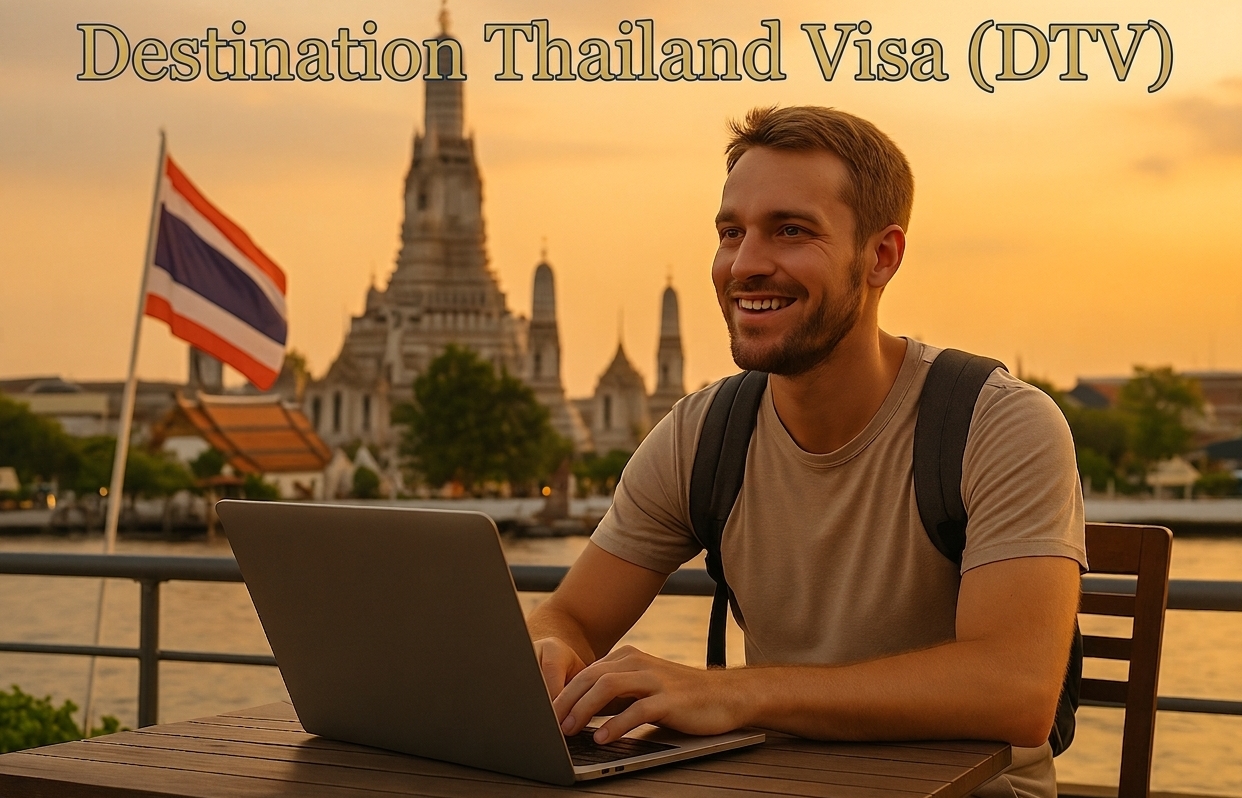
Thailand’s Destination Thailand Visa (DTV) is one of the most flexible long-term visas for remote workers, digital nomads, location-independent freelancers, and cultural enthusiasts.
Offering a 5-year validity period with multiple entries, each entry allows you to stay in Thailand for up to 180 days.
However, navigating the application process requires understanding key rules, document requirements, and recent immigration updates.
Here is everything you need to know to secure your DTV.
1. DTV Quick Facts & Snapshot
| Feature | Details |
| Visa Validity | 5 Years (Multiple Entry) |
| Stay Length | Up to 180 days per entry (extendable once in-country or reset by a border run) |
| Government Fee | ~10,000 THB (varies slightly by local embassy currency) |
| Main Financial Requirement | Equivalent of 500,000 THB (~$14,500–$17,000 USD) in bank balance |
| Work Rights | Remote work/foreign clients allowed (No local Thai work permit or local payroll) |
| Dependents | Covers legal spouse and unmarried children under 20 |
2. Who Qualifies for the DTV?
Applicants must fall under one of three main categories:
-
Workcation (Digital Nomads, Freelancers, Remote Employees): Individuals working for foreign companies, running overseas businesses, or freelancing with international clients.
-
Thai Soft Power & Cultural Activities: Participants in long-term Muay Thai training, Thai cooking courses, sports training, seminars, or medical treatment plans. (Note: Standard language schools generally do not qualify under DTV).
-
Dependents: Legal spouses and children under 20 years old of primary DTV holders.
3. Mandatory Requirements & Document Package
Every applicant must assemble a general document package along with specific category-based evidence:
General Requirements (All Applicants)
-
Valid Passport: Must have at least 6 months of validity remaining.
-
Passport Photo: Recent passport-sized color headshot with a white background.
-
Financial Proof: Bank statements showing a minimum balance of 500,000 THB held in a personal account. (Note: Cryptocurrencies, investment portfolios, and brokerage accounts are strictly not accepted).
-
Proof of Residence: Official proof of permanent residency or legal residence status in the country where you submit your application. You cannot apply from a third country where you are merely visiting on a tourist status.
-
Police Clearance: A valid criminal record clearance certificate issued by the relevant authority in your country of nationality or legal residence.
Category-Specific Requirements
-
Remote Employees: Employment contract or employer letter confirming your remote status, salary, and permission to work overseas.
-
Freelancers / Business Owners: Certificate of incorporation/business registration, active client contracts, invoices, tax returns, or a professional portfolio (e.g., website, GitHub, LinkedIn profile).
-
Soft Power Participants: Official letter of acceptance/enrollment from a legally registered institution (e.g., Muay Thai gym, culinary institute, or hospital) showing an activity duration.
-
Dependents: Proof of relationship such as a marriage certificate or official birth certificate.
4. How to Apply: Step-by-Step
5. Staying in Thailand on a DTV
-
180-Day Stamp: Each time you enter Thailand, immigration will stamp you in for 180 days.
-
Extensions vs. Border Runs: You can apply for a one-time 180-day extension at a local Thai immigration office for a fee of 1,900 THB.
However, exiting Thailand for a short trip (border run) and re-entering automatically resets your 180-day stay without requiring local extension paperwork. -
Tax Considerations: DTV holders earning foreign-sourced income from remote work are generally subject to Thai tax rules if they reside in Thailand for 180 days or more in a calendar year. Consult a Thai tax professional if you intend to remain in the country long-term.
Summary Checklist Before Applying
-
Balance of 500,000 THB liquid cash in personal savings.
-
Clear proof of foreign remote work, business ownership, or soft power enrollment.
-
Valid police clearance certificate.
-
Proof of residence in your application country.
-
Application submitted via thaievisa.go.th while outside Thailand.
Support our work: Click Here
Best Travel Insurance: click here
Best VPN for Travel: click here
Have any thoughts?
Share your reaction or leave a quick response — we’d love to hear what you think!
-
 0
-
 0
-
 0
-
 0
-
 0
-
 0