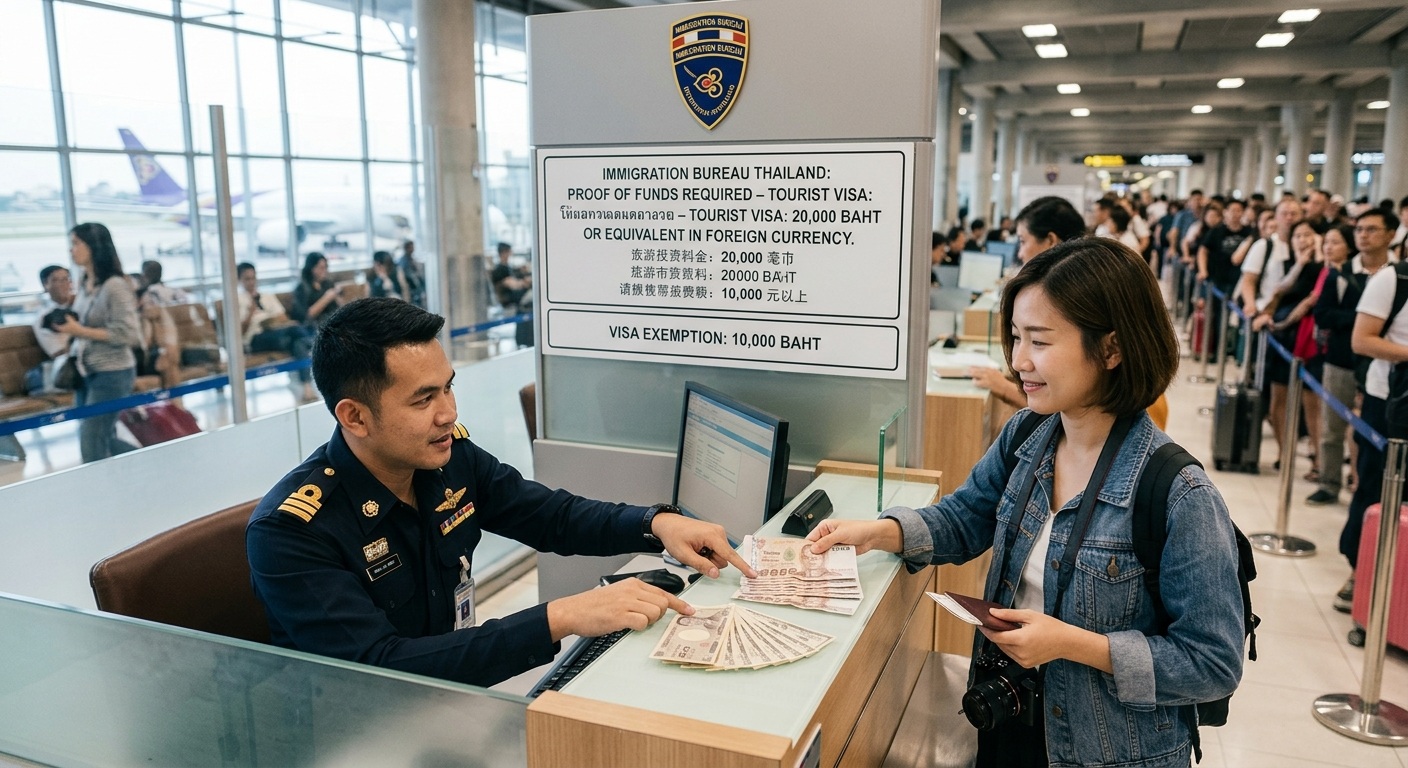
You’ve booked your flights, secured your hotel in Thailand, and packed your bags for paradise. But right before you step up to Thai Immigration, one crucial question remains: Could you be asked to show proof of cash at the border?
The short answer is yes. While thousands of travelers breeze through immigration daily without incident, Thai border officials have the legal right to ask visitors for physical proof of funds upon arrival.
To help you avoid any last-minute surprises at Suvarnabhumi, Phuket, or Don Mueang, here is everything you need to know about Thailand’s proof-of-funds rules, and how much money you should actually carry.
The Legal Requirements by Visa Category
Thailand’s official proof-of-funds requirements aren’t a new creation, they stem from long-standing Ministry of Interior immigration regulations.
The official financial thresholds depend directly on the type of entry method or visa you are using:
| Entry / Visa Category | Requirement Per Person | Requirement Per Family |
| Visa Exemption (Standard Rule) | 10,000 THB | 20,000 THB |
| Tourist Visa (TR) | 20,000 THB | 40,000 THB |
| Visa on Arrival (VOA) | 10,000 THB | 20,000 THB |
| Non-Immigrant Visas (ED, O, B, etc.) | 20,000 THB | 40,000 THB |
| Transit Visas | 10,000 THB | 20,000 THB |
Note: Children under the age of 12 are generally exempt from this check.
The Visa-Exempt Gray Area: 10,000 vs. 20,000 THB
If you are entering Thailand without a visa under a Tourist Visa Exemption scheme, this is where most online confusion happens.
While Tourism Authority of Thailand (TAT) baseline guidelines cite 10,000 THB per individual, several Royal Thai Embassies (including in Washington D.C., London, and Europe) officially instruct travelers to carry 20,000 THB per person (or 40,000 THB per family) when using the visa-exempt scheme.
Pro-Tip: If you are traveling visa-free, play it safe. Preparing to show the higher figure of 20,000 THB per person ensures you meet all possible embassy interpretations and eliminates any risk of immigration hiccups.
Does It Have to Be Cash in Thai Baht?
Not necessarily, but cash is king at border control.
According to official guidelines, funds can be presented in:
-
Physical Thai Baht (THB)
-
The equivalent value in major foreign currencies (e.g., USD, EUR, GBP, AUD, SGD)
Can I just show my banking app or credit card?
Officially, credit cards and banking mobile apps do not guarantee acceptance.
While individual officers occasionally accept digital bank balances or printouts, border regulations specifically emphasize readily accessible physical currency.
Relying solely on a plastic card or a smartphone screen is a risky gamble, if an officer strictly enforces the rule and you cannot produce tangible cash or proof, you could face entry delays or denial.
Will Immigration Actually Check You?
Most casual tourists with clean passports, return flight tickets, and confirmed hotel bookings are rarely asked to show proof of funds.
However, immigration officers exercise total discretion. Checks are significantly more frequent if:
-
You have spent extended periods in Thailand recently on back-to-back tourist entries or “visa runs.”
-
Your passport shows multiple entry stamps without a long-term visa.
-
You do not have proof of onward travel out of Thailand within your permitted stay.
Remember: Holding a valid visa or qualifying for visa-free entry does not automatically guarantee entry.
The final decision always rests with the immigration officer on duty.
Checklist: What to Pack for Smooth Entry
To ensure a stress-free arrival at Thai border checkpoints, always keep these items easily accessible in your carry-on luggage (never in checked baggage):
-
Physical Cash: The equivalent of 20,000 THB in your local currency or Thai Baht.
-
Passport: Valid for at least 6 months beyond your travel date.
-
Return/Onward Flight Details: Printed or saved offline.
-
Accommodation Details: Hotel booking confirmation or address of where you’re staying.
-
Digital Arrival Card: Completed beforehand if required by current regulations.
Have any thoughts?
Share your reaction or leave a quick response — we’d love to hear what you think!
-
 0
-
 0
-
 0
-
 0
-
 0
-
 0