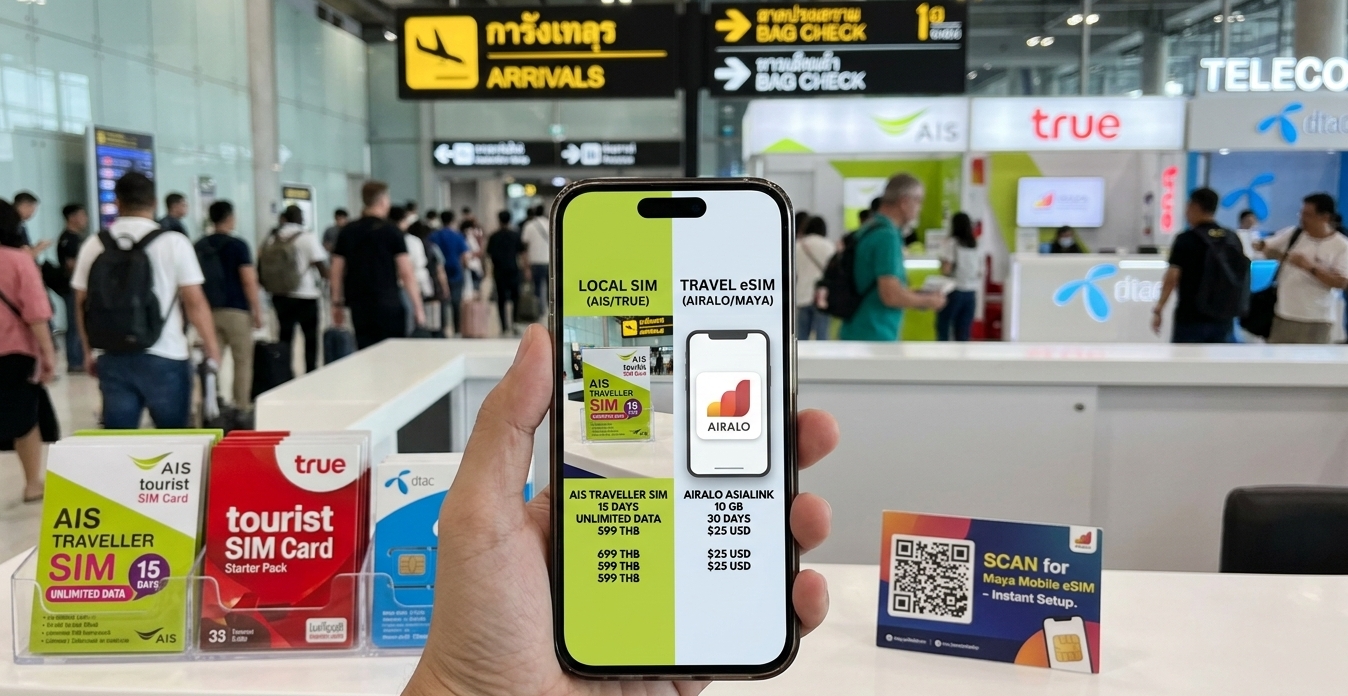
Staying connected in Thailand isn’t just about sharing photos; it is essential for calling a Grab (the local Uber equivalent) in Bangkok, translating menus with Google Lens in Phuket, scanning PromptPay QR codes in Koh Samui, and navigating island routes in Chiang Mai.
While getting online upon arrival is straightforward, choosing the wrong setup can cost double or leave you stranded without service on remote islands.
1. Network Landscape: Who Rules the Signal in Thailand?
Thailand’s mobile market relies on two dominant network providers:
-
AIS (Advanced Info Service): Widely regarded as the gold standard for coverage. AIS delivers reliable 5G across major cities and holds strong connectivity on remote islands (e.g., Koh Lipe, Koh Kood, or national park trekking trails).
-
True Corp (True & DTAC): Following their merger, True and DTAC share infrastructure, forming Thailand’s largest network by user count.
Coverage in cities, beaches, and tourist hubs matches AIS, though AIS often holds a slight edge in ultra-remote spots.
2. Comparing Connectivity Options
| Feature | Airport Kiosk Physical SIM | Travel eSIM (Airalo / Maya Mobile) | Official Local eSIM (AIS / True Online) | Convenience Store SIM (7-Eleven) |
| Best For | Zero pre-planning | Immediate connectivity upon landing | Long stays, maximum speed & local phone number | Budget travellers willing to navigate registration |
| Price Point | High ($15–$30) | Medium ($5–$25) | Low to Medium ($10–$20) | Ultra Low ($3–$8 + top-ups) |
| Setup Effort | Low (Staff swaps SIM) | Very Low (Scan QR code at home) | Medium (Online ID verification) | Medium (Passport scan at counter) |
| Local +66 Number | Yes | Optional (Data-only by default) | Yes | Yes |
3. Option Breakdown: What’s Worth It?
Option A: Travel eSIMs (Airalo, Maya Mobile, Nomad)
-
The Pitch: Purchase and install a digital SIM on your phone before stepping onto the plane.
-
Pros: Connect to local networks the second your flight touches down at Suvarnabhumi (BKK) or Phuket (HKT). No physical SIM tray fiddling, no airport queues, and you keep your primary home SIM active for 2FA SMS codes.
-
Cons: Often slightly more expensive per GB than local packages. Most travel eSIMs provide data-only profiles without a local
+66telephone number (though data calls via WhatsApp/Line work fine).
Option B: Local Carrier eSIMs (Direct via AIS or True websites)
-
The Pitch: Buy an official local eSIM directly from AIS or TrueMove H online prior to departure.
-
Pros: You get full local 5G network speeds, unlimited data packages, and a native Thai phone number—useful for booking local restaurants or receiving SMS confirmations.
-
Cons: Requires completing online identity verification (uploading a passport scan) during setup.
Option C: Airport Kiosk Physical SIM / eSIM
-
The Pitch: Buy a tourist package right after exiting customs at the airport.
-
Pros: Convenience. Staff will physically register your passport, install the SIM card, and hand your phone back fully configured.
-
Cons: The “Tourist Tax.” Airport counters sell premium tourist packages (e.g., $30 for 15 days unlimited) that cost significantly more than standard local rates. Lines can also be long during peak flight arrival windows.
Option D: City Convenience Store / Official Retail Shops (7-Eleven, Central Malls)
-
The Pitch: Skip the airport counters and pop into any 7-Eleven or official AIS/True store in downtown Bangkok, Chiang Mai, or Phuket.
-
Pros: Access to standard local non-tourist rates. You can pick up a base SIM card for as little as 49-99 THB ($1.50-$3.00) and top up data packages via the carrier’s app.
-
Cons: Requires finding Wi-Fi to travel to your hotel first. 7-Eleven staff may occasionally face language barriers with passport registration procedures.
The Verdict: Which Should You Choose?
-
For 1–2 Week Vacationers: Travel eSIM (Airalo / Maya Mobile) wins on convenience. Buy a 10GB–Unlimited package before leaving home to avoid waiting in airport queues after a long flight.
-
For Digital Nomads & Long-Term Visitors: Get an Official AIS local SIM or eSIM. You’ll want maximum 5G speeds, lower monthly rates, and a local phone number for app registrations.
-
For Budget Travelers: Use airport Wi-Fi to reach your hotel, walk to the nearest 7-Eleven with your passport, and grab a local prepay SIM.
Support our work: Click Here
Best Travel Insurance: click here
Best VPN for Travel: click here
Have any thoughts?
Share your reaction or leave a quick response — we’d love to hear what you think!
-
 0
-
 0
-
 0
-
 0
-
 0
-
 0