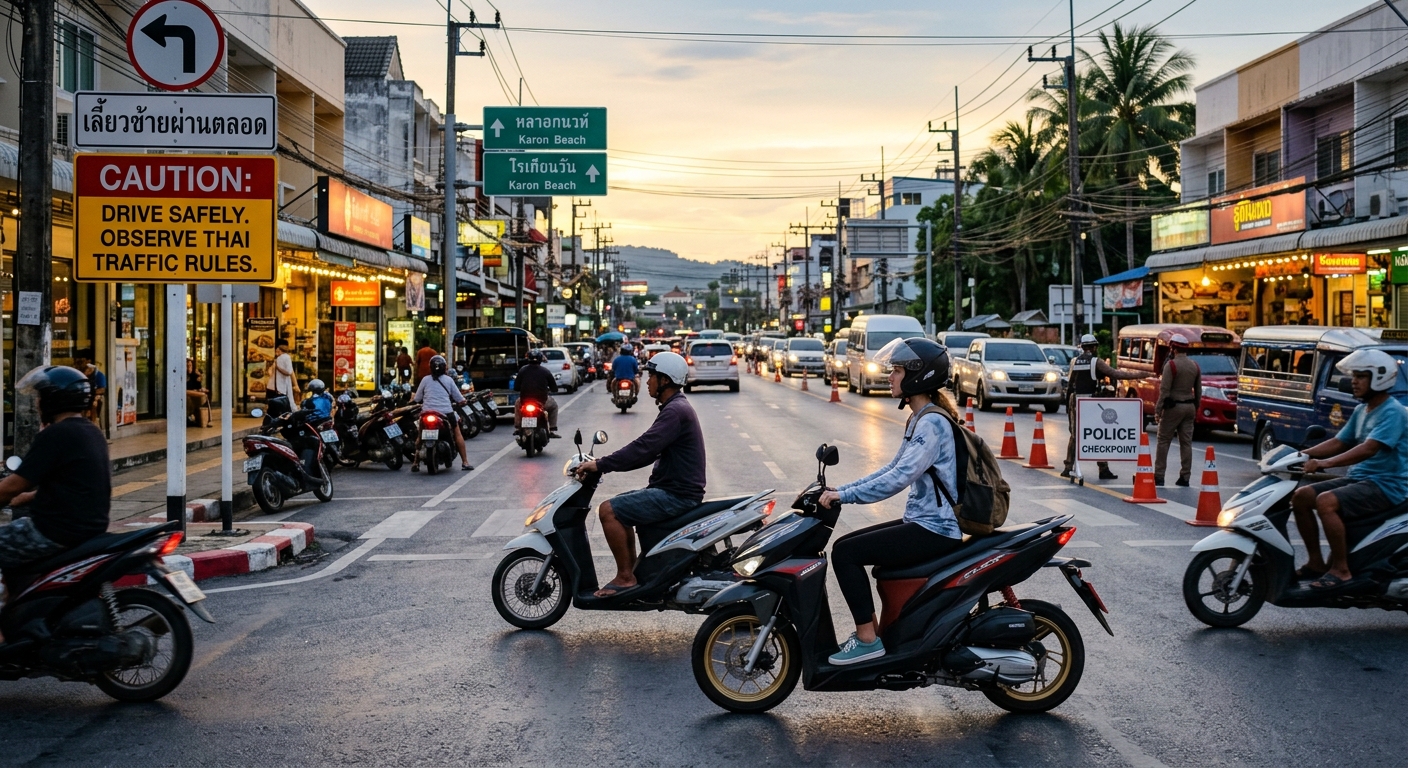
Renting a car or a 125cc /160cc scooter is the ultimate dynamic for exploring Thailand.
It gives you complete freedom to skip the overpriced tuk-tuks, duck into hidden alleys, and reach remote viewpoints on your own schedule. But for drivers and riders used to rigid Western traffic laws, stepping into Thai traffic can feel like jumping straight into a high-stakes game of Frogger.
Traffic in Thailand isn’t chaotic, it’s fluid. Once you understand the local driving etiquette, common traffic patterns, and legal requirements, riding here becomes second nature.
Here is everything you need to know to stay safe, avoid police fines, and ride like a seasoned local.
1. Local Driving Customs & Unwritten Rules
To survive and thrive on Thai roads, you need to throw out a few textbook driving rules and adapt to how traffic actually flows.
-
Fluid Right-of-Way: In many Western countries, right-of-way is absolute. In Thailand, right-of-way belongs to whoever is ahead of you or whoever moves first. Never assume someone will yield just because a sign says they should.
-
The “Ghost Rider” Phenomenon (Yon Sorn): Expect scooters (and occasionally pickup trucks) to drive against traffic along the shoulder. If you are turning left onto a main road, check both directions, even on a one-way street or dual carriageway.
-
The Left-Turn-On-Red Rule: Turning left at a red light is generally permitted unless a sign explicitly states otherwise (Look for “เลี้ยวซ้ายผ่านตลอด”). However, you must yield to oncoming traffic from the right.
-
Flash of High Beams = “I Am Not Stopping”: In Western driving, flashing high beams usually means “Go ahead, I’m letting you through.” In Thailand, it means the exact opposite: “Get out of my way, I am coming through and not slowing down.”
-
Horn Etiquette: Honking loudly is considered aggressive. Locals use short, light double-taps (“beep-beep”) purely as an auditory proximity warning when passing in a blind spot or taking a sharp mountain hairpin.
2. Navigating Police Checkpoints Legally
Police checkpoints (Daan) are common in major tourist hotspots like Phuket, Chiang Mai, Pattaya, and Koh Samui.
They are typically setup on main coastal roads, near beach towns, or right after major intersections.
The goal isn’t just “avoiding” them, it’s being 100% legally bulletproof so a 2-minute stop doesn’t cost you cash or hassle.
What You Need to be 100% Legal
To clear any traffic stop legally, you must carry three things if you don’t have a local thai driving license:
-
International Driving Permit (IDP): You must have an IDP issued under the 1968 Convention (or 1949) with the Motorcycle endorsement (Class A) stamped. A home car license alone is invalid.
-
Original Home Drivers License: The IDP is only valid when presented alongside your original domestic car or motorcycle license.
-
Registration & Insurance Documents: Kept under the scooter seat (a copy of the green registration book / Green Book and mandatory Por Ror Bor insurance).
Common Fines & Legal Pitfalls
| Violation | Typical Fine | The Catch |
| No Helmet (Driver or Passenger) | 500 – 1,000 THB | Both rider and passenger must wear helmets. |
| No Valid License / IDP Car or Motorcycle Stamp | 500 – 1,000 THB | You can be fined again at a different checkpoint after 24 hours. |
| Driving on the Sidewalk / Bus Lane | 1,000 – 2,000 THB | Strictly enforced in Bangkok and urban zones. |
| DUI / Drink Driving | Up to 20,000 THB + Court | Zero tolerance. Can lead to detention and deportation. |
Critical Insurance Warning: If you ride without a valid car or motorcycle license + IDP car or motorcycle stamp, your travel insurance and rental insurance are completely void. If you crash, you will pay 100% of all medical bills and property damage out of pocket.
3. Deciphering Common Thai Traffic Patterns
The “Scooter Swarm” at Red Lights
When stopping at red lights on a motorbike, do not sit in line behind cars. Filter safely between vehicles to reach the front box or space near the stop line.
When the light turns green, scooters accelerate fast together to clear the intersection before heavy car traffic moves.
U-Turn Loops & Medians
Direct right turns across multi-lane highways are rare. Instead, traffic uses designated U-turn slots.
-
Slow down in the far-right lane or designated U-turn lane.
-
Watch for large vehicles swinging wide.
-
When executing the U-turn, merge into the shoulder lane first, gain speed, and then merge into the main flow.
Wet Roads & Oil Sheen
During sudden tropical downpours, oil residue on asphalt rises to the surface, making roads slick within minutes.
-
Avoid braking over white street markings or metal drain covers, they become as slippery as ice.
-
Reduce speed by half and double your braking distance during the first 15 minutes of rain.
4. Essential Motorbike Gear for Thai Roads
Riding in 32°C (90°F) heat makes heavy leather gear impractical, but riding a scooter in a swimsuit, flip-flops, and no shirt is a recipe for severe road rash (affectionately called “Thai Tattoos”).
Strike a balance between safety and heat management:
                  ┌─────────────────────────────────────┐
                  │          FULL-FACE / 3/4            │
                  │          ECE-R 22.05 HELMET         │
                  └──────────────────┬──────────────────┘
                                     │
                  ┌──────────────────┴──────────────────┐
                  │       UV BREATHABLE LONG-SLEEVE     │
                  │          OR RIDING SHIRT            │
                  └──────────────────┬──────────────────┘
                                     │
                  ┌──────────────────┴──────────────────┐
                  │       VENTILATED RIDING GLOVES      │
                  │         WITH KNUCKLE PROTECTION     │
                  └──────────────────┬──────────────────┘
                                     │
                  ┌──────────────────┴──────────────────┐
                  │       CLOSED-TOE SNEAKERS           │
                  │        (NEVER FLIP-FLOPS)           │
                  └─────────────────────────────────────┘
-
Helmet with a Face Shield: Rental helmets are notoriously flimsy (“egg shells”). Spend 800–1,500 THB at a local shop (like AutoBac or Big C) to buy a certified 3/4 or full-face helmet (look for TIS or ECE standards). A clear visor protects your eyes from dust, gravel, and heavy bugs at night.
-
Breathable Long Sleeves: Lightweight UV-blocking hoodies or linen shirts protect you from intense sun fatigue during long daytime rides.
-
Padded Gloves: In even a minor 15 km/h slide, your hands hit the pavement first. Breathable mesh riding gloves keep your hands intact and grip steady when sweaty.
-
Closed-Toe Shoes: Always wear sneakers or sturdy footwear. Never wear flip-flops, you need foot grip when stopping at oil-slicked lights or maneuvering uneven terrain.
And if you don’t feel secure driving a car or riding a scooter in Thailand, there are various reliable transport apps to use, check out our guide: What are The Best Transport Apps and Safety Tips for Getting Around Thailand?
Support our work: Click Here
Best Travel Insurance: click here
Best VPN for Travel: click here
Have any thoughts?
Share your reaction or leave a quick response — we’d love to hear what you think!
-
 0
-
 0
-
 0
-
 0
-
 0
-
 0